 |  |
Women are More Than Just a Pretty Face
When asked, “What did a woman in the Wild West do?” one might think of things such as sewing, cleaning, cooking, caring for the children, or even working in a brothel. Movies about the 19th Century portrayed the typical woman as weak and defenseless. They were either taking care of the house while the husband works or they are working in the saloons as the object of the man’s desire for the night. Few movies gave the impression that women were able to think on their own and fight for themselves. They don’t show the women that did all the things the men did and more. Many women in the Wild West did not fit the mold of the typical woman as depicted in video; they were independent and strong and they have their part in the history of the Wild West. They often times outshined their male counterparts.
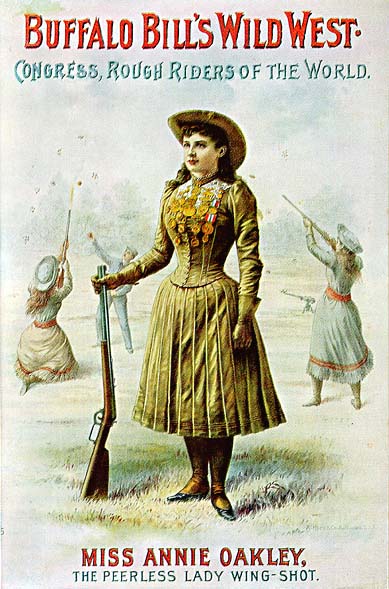
The men of The Wild West were known to be the ones who carried guns and hunted for food. They were the ones who were looked upon to protect the family. Historically, they are looked at as the providers for the family. However, one woman, Annie Oakley, stood out and fulfilled this role and more after the death of her father. Annie’s father passed away when she was six years old. Annie ran away from home at the age of twelve and returned when she was fifteen. Not only did Annie come back home and support her family, she came back and became the primary supporter (Kim-Brown 2).
Annie earned money by shooting game and selling the meat to the Katzenberger brothers’ grocery. Her business was so successful that she was able to pay off the mortgage on her mother’s house. Just a teenager at the time, Annie brought in the majority of the money, started her own business, and went hunting; three items traditionally done by a man during The Wild West. Annie later became known for her sharpshooting skills. She entered multiple sharpshooting skills competitions; winning so many turkey shoots that she was banned from entering them. Annie Oakley earned her reputation as a sharpshooter when she challenged professional sharpshooter Frank Butler. Frank was traveling through southern Ohio claiming that he could outshoot anyone. The locals took Frank up on his challenge and put him up against Annie. Annie defeated the famous Frank Butler at his own game, winning tickets to his next show. This marked the beginning of Annie and Frank’s relationship. They later married and worked together (Kim-Brown 2).
After their marriage, Annie joined Frank’s show, becoming the main focus of what the audience wanted to see. Frank gladly faded into the background in his own show as Annie stepped into stardom. Filmmaker Riva Freifield stated about Frank Bulter, “he basically created a situation where you had a role reversal of a typical Victorian marriage." Annie and Frank later joined Buffalo Bill’s Wild West show. Buffalo Bill was reluctant to hire Annie at first, even turning her down the first time she asked. Annie was put low on the bill but soon moved up as Buffalo Bill saw that Annie was attracting women and children to the show. Her showmanship and fame began to spread, making Annie the star that we know her as today (Kim-Brown 3).
Other women were remembered in different ways than Annie Oakley, some were outlaws. Myra Maybelle Shirley, aka Belle Starr, was said to be a “Bandit Queen, a lovely lady who ruled outlaw gangs with her guns, her will, and her personal favors” (Arnott 2). Historians question some of the acts she is remembered for. She was credited with activities such as stealing from the rich and giving to the poor, fixing crooked poker games with her guns, and riding down streets with her pistols blazing (Arnott 2). Belle was known to robbing stagecoaches, killing lawmen, and providing refuge for various outlaws (Haverkamp 1). While some of the facts of her life are questioned, one thing that historians can agree upon is her ties to numerous outlaws.
For example, Belle’s first husband was Jim Reed. Jim was known for multiple murders, robbing stagecoaches, and stealing livestock. Jim was nearly captured in 1874. Instead of surrendering, he attempted escape and was shot and killed in his attempt. After his death, stories of Belle suggest that she took part in such activities as burning down a store, robbing a bank, being arrested for horse theft, and fencing stolen livestock. Belle eventually married again in 1880; this time to Sam Starr (Arnott 4).
The first record of Belle and Sam after their marriage was when they were arrested for horse theft in 1882. Belle was charged for two counts of theft while Sam was only charged with one. She and Sam were sentenced to twelve months in the House of Correction in Detroit. Belle is rumored to have convinced the warden into appointing her as his assistant. After serving only nine months of their sentence, they were released (Arnott 7). The judge’s hopes of Belle and Sam becoming model citizens fell by the wayside.
Independently, Belle was arrested again in January 1886 for larceny. The trial was set for September 1886. During the next few months, Belle stayed active in her endeavors. There were multiple farms robbed in February by three individuals. One of the individuals was a woman dressed as a man. A witness identified Belle Starr as the woman involved. She was arrested in April for the robberies although she was never convicted (Arnott 8).
In September, Belle also received a not guilty plea of her larceny charge. Unfortunately, upon returning home from her trial she had found that Sam was fatally wounded. Upon his death, Belle had a brief relationship with notorious outlaw Jack Spaniard. Their relationship was cut short when Spaniard was arrested for murder and hanged. She then married Bill July, another outlaw related to her late husband, so that she could reclaim the land previously owned by Sam Starr. On February 2, 1889, Belle was shot and killed by an unknown assailant. Belle Starr’s killer was never found, adding to her legacy, helping carrying her name through history (Arnott 2).
Belle’s marriage to numerous outlaws was not her only tie to criminals. She was said to have housed the famous Jesse James at her ranch shortly before he was killed. She also aided the escape of wanted murderer John Middleton. In 1886, she posed for a picture next to convicted murdered Blue Duck. Because of the picture, she was falsely portrayed as the wife of Blue Duck. Belle became the most feared woman outlaw in the West (Haverkamp 2).
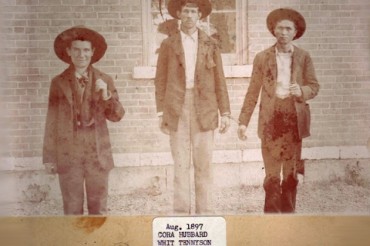
Following in the footsteps of Belle Starr was Cora Hubbard. Cora’s husband Bud Parker and his associates drew up a plan to rob a nearby bank in Pineville, Missouri. When the time came to carry out the plan, Bud Parker backed out. Cora was furious with her husband took charge of the gang. She set out with two of the members stating she would not live with a coward. Cora took charge of the gang as they entered Pikeville. The two followers, Sheets and Tennyson, were sent ahead to scout the area and report back to Cora. They found no reason not to follow through with their plans so Cora, Sheets, and Tennyson headed toward the bank (Wood 1).
Upon arriving at the bank, Cora pointed her gun at the landowner’s son, telling him “It’s no use to get excited at a time like this” (Wood 1). The three outlaws completed their robbery and headed out of town. Later Tennyson was capture and revealed the identities of his acquaintances. When the news got out that one of the three was a woman, Cora was labeled as the “Second Belle Starr” by a local paper (Wood 2). Cora and Sheets were later arrested. Cora and Sheets were each sentenced to 12 years in prison while Tennyson was sentenced to 10. (Wood 3). Cora told the Daily Herald that she was “not a damn bit afraid during the robbery and suggested her only regret was that she and her accomplices hadn’t help up the whole damn town” (Secrest 1).
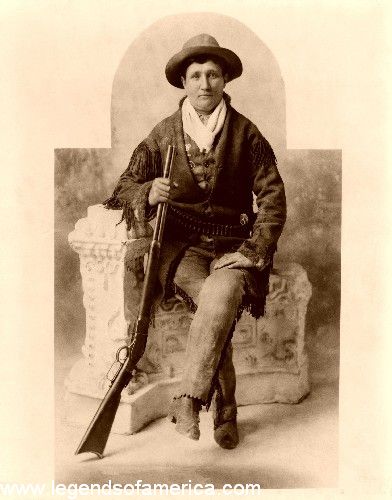
Calamity Jane was on the other side of the law from Cora and Belle, but she had her wild side too. She was known to drive and wrestle cattle, shoot and fight ferociously, wear men’s clothes, drink excessively, chew tobacco, and swear. She was also known for her nursing skills, her success as an army scout, and her loving attitude towards her children (Simon 6). She is arguably one of the most famous women in the history of the Wild West (Secrest 1).
Jane’s fame comes from her ties to numerous famous individuals of the Wild West. A story told by a friend and famous cowboy, Buffalo Bill Cody, tells of how Jane possible got the name Calamity Jane. Jane was following behind a group of soldiers when they were attacked by Native Indians. The regiment leader was hurt in the battle. Seeing what had happened, Jane rode into the middle of the battle, grabbed the soldier, and rescued him to safety. Due to the “calamity” of the event, she was dubbed as Calamity Jane (Simon 6). Buffalo Cody wasn’t the only famous cowboy that Jane had as an acquaintance. One of the more well-known stories regarding Calamity Jane was her relationship with Wild Bill Hickok.
Jane arrived in South Dakota in 1876 with a small group of travelers led by Wild Bill Hickok. Stories suggest that Wild Bill and Calamity Jane had a love affair. Some historians refute the possibility of the affair; however Jane herself suggested it to be true. She also claims to have given birth to Wild Bill’s daughter. Upon her death, Jane requested to be buried next to Wild Bill. Her request was granted as they currently lie next to each other in South Dakota (Simon 8).
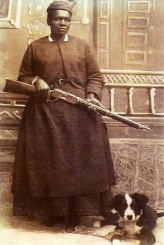
It wasn’t always the elaborate things such as shows, robberies, or murder that marked a woman’s place in history. Mary Fields was “one of the most picturesque characters in the history of Montana” (Cooper 1). Mary’s biggest claim to fame was that she was the second ever woman stagecoach driver to drive a U.S. mail route between Cascade, Montana and St. Peter’s Mission. However, other characteristics set her apart from the typical woman. She was born a slave in Tennessee. Due to being an African American, she wasn’t bothered by Native Americans during her route on the stagecoach. Mary’s love of liquor was matched only by her ability to put it away. She received special permission from the mayor of Cascade, Montana that allowed her to drink in the saloons with the men. (Cooper 1) However, it isn’t her claim to fame that sets Mary apart from the typical woman.
Mary moved to Montana in 1884 to be with her friend, Mother Amadeus, in time of need. The winter was bitter cold and Mother Amadeus had pneumonia. Mary nursed her back to health and ended up staying in Montana to help the missionaries with the hard labor (Cooper 3). Some of her duties included washing laundry, buying supplies, maintaining the garden and grounds. She often freighted for the mission and traveled the prairies through the night fighting storms and the dangers of the open field. One night a pack of wolves frightened her team of horses. Mary stayed up all night guarding the cargo, walking back and forth to keep from freezing to death (Cooper 3). Despite her caring nature, Mary also had her bad side.
Mary was tall and weighed well over 200 pounds. She wore men’s clothes, carried a .38 Smith and Wesson revolver, and never backed down from an argument or fight (Reindl 1). She had a bad temper and didn’t fear man or beast. Numerous complaints were filed against Mary over her ten years working at the mission, eventually getting her kicked out (Cooper 3). A few years after leaving the mission Mary ventured into the stagecoach mail route.
Mary never missed a mail route. If the weather was too bad for the coach to get through, Mary was known for carrying the baggage and walking the route so that she could make the delivery. Often times, Mary slept at the depot so that she knew she wouldn’t miss the train (Cooper 3). Mary was nearly 70 years old when she quit running the mail route. Afterwards, she started her own laundry business (Reindl 2).
She was so loved by the townspeople that when her business burned down in 1912, the people of the town volunteered labor and materials to help her rebuild her home. Mary spent the last few years of her life as a babysitter. She charged $1.50 per day and spent nearly all of the money buying candy for the children of the town (Reindl 2).
Like Mary Fields, Nellie Cashman often put the needs of others before her own desires. He lived her entire life in search riches. In 1869, she left Boston and headed for San Francisco, with several stops along the way. By 1872, she was living in Nevada. She opened a boardinghouse there and provided need to those less fortunate. She provided them with food, places to sleep, and small loans to miners in need. She didn’t find her pot of gold in Nevada, but she made lots of friends with her generosity and kindness (Fisher 2).
Nellie headed to Dease Lake, British Columbia in 1877 when the word got out that gold was discovered there. She began a long and treacherous journey. Most would have given up during the trip, but Nellie continued on. Once she arrived at her destination, she set up a boardinghouse and prospected for gold in her spare time. She didn’t get rich off of gold while there, but her boardinghouse business proved to be profitable. Nellie left Dease Lake and headed to the capital of British Columbia to get supplies because she and her companions were running low. While there, she gave $500 to the sisters of St. Anne to help them build a hospital. Shortly after arriving, she received word that some of the miners were ill with scurvy (Fisher 1).
To help the sick, she purchased nearly a ton of potatoes, lime juice, and other items containing vitamin C. The purchased items weighed close to 1500 pounds, so she recruited half a dozen men to help her get them back to Dease Lake. They group spent 80 days in the middle of winter carrying supplies through snow and freezing winds. Upon reaching her destination, Nellie discovered that 85 of the 200 miners had scurvy. She was able to nurse all but a few of them back to good health. Nellie left British Columbia and moved to Tombstone, Arizona Territory. (Fisher 1)
While in Tombstone, Nellie’s accomplishments include opening the Nevada Boot and Shoe store, the Tombstone Cash Store which sold groceries and supplies, the Arcade Restaurant, helping build the first Catholic Church, and hold fund raisers for charitable causes. She became one of the leading citizens in Tombstone. She was referred to as the Angel of Tombstone. Nellie’s generosity continued on through her life as she always put others before herself. She never got rich by finding her pot of gold, but she did well for herself through her various businesses she opened and maintained (Fisher 3).
None of these women fitted the typical mold of a woman in The Wild West. They each had their own claim to fame by being an entertainer, outlaw, business developer, or generosity and constantly putting the needs of others before themselves. Not all of these women are the names you think of when you think of The Wild West, but what would the West be without these women. If there was no Annie Oakley in the Wild West show, would it have been so popular since she was the reason many bought tickets. If Nellie didn’t start all of her business adventures or save the lives of the miners, then what would have happened to all parties impacted by her generosity and compassion.
Works Cited
Arnott, Richard D. "Bandit Queen Belle Starr. (cover story)." Wild West 10.2 (1997): 34. MasterFILE Premier. EBSCO. Web. 2 Mar. 2011.
Cooper, Gary, and Marc Crawford. "Stagecoach Mary." Ebony 32.12 (1977): 96. MasterFILE Premier. EBSCO. Web. 17 Feb. 2011.
Fischer, Ron W. "Nellie Cashman challenged the west's mining frontiers.." Wild West 10.3 (1997): 72. MasterFILE Premier. EBSCO. Web. 19 Feb. 2011.
Haverkamp, Beth. "Bad women and bandit queens." Cobblestone 17.5 (1996): 20. MasterFILE Premier. EBSCO. Web. 3 Mar. 2011.
Kim-Brown, Caroline. "Little Sure Shot: The Saga of Annie Oakley." Humanities 27.3 (2006): 14. MasterFILE Premier. EBSCO. Web. 20 Feb. 2011.
Reindl, JC. "'Stagecoach Mary' broke barriers of race, gender: Ex-slave often omitted in local annals." Blade, The (OH) 08 Feb. 2010: Newspaper Source. EBSCO. Web. 5 Mar. 2011.
Secrest, William B. "The Calamities of Calamity Jane." Wild West 23.5 (2011): 56. MasterFILE Premier. EBSCO. Web. 19 Feb. 2011.
Simon, Jenni. "Calamity Jane and the American West: Gender Constructions in Western Myth." Conference Papers -- National Communication Association (2007): 1. Communication & Mass Media Complete. EBSCO. Web. 4 Mar. 2011
Wood, Larry. "The 'Second Belle Starr' was arrested for her role in a bank robbery in Pineville, Missouri." Wild West 17.1 (2004): 12. MasterFILE Premier. EBSCO. Web. 20 Feb. 2011.
 |  |
